
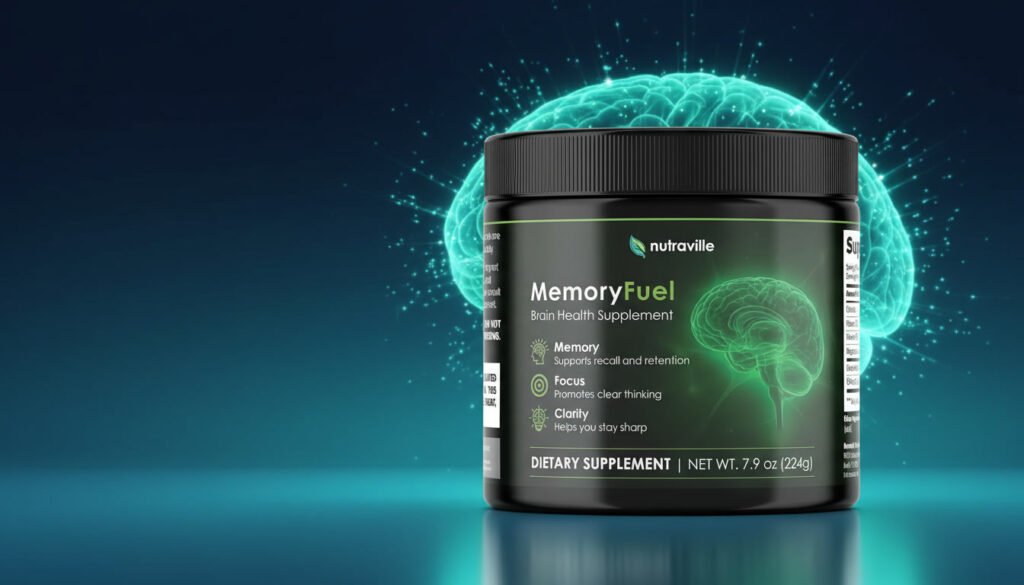
MemoryFuel Review by Natasha Morgan
Quick Verdict: What Is MemoryFuel?
MemoryFuel is a non-stimulant brain health supplement manufactured by Nutraville, containing Vitamin D3, B12 (methylcobalamin), Magnesium Glycinate, Creatine Monohydrate, Choline, and Bacopa Monnieri. I tested it for 90 days, and while my focus and mental clarity improved noticeably, the exact ingredient dosages are not fully transparent, the official website has a low trust score, and I experienced mild digestive issues during the first two weeks.
My Rating: 4.5 out of 5
Key Details:
| Feature | Details |
|---|---|
| Product Type | Dietary Supplement (Brain Health/Nootropic) |
| Manufacturer | Nutraville |
| Form | Powder |
| Price | ~$43 per bottle (~$1.43 per day) |
| Guarantee | 90-Day Money-Back |
| Key Ingredients | Creatine, Choline, Vitamin D3, B12, Magnesium, Bacopa Monnieri |
| Best For | Adults 30–65 seeking non-stimulant cognitive support |
| My Experience | Improved focus, mild GI upset, gradual results |
Check the Latest Price on the Official MemoryFuel Website →
Why I Decided To Try MemoryFuel
I’m 38 years old, a freelance writer, and a mother of two. For the past year, I’d been struggling with something I couldn’t quite name. It wasn’t severe forgetfulness — I wasn’t losing my keys or forgetting appointments. It was subtler than that. I’d sit down to write, and my brain would feel… foggy. Like there was a layer of static between my thoughts and my fingertips. I’d read the same paragraph three times without absorbing it. By 2 PM, my mental energy would plummet, and I’d reach for coffee — which only made me jittery, not sharper.
I’d tried meditation apps, sleep tracking, and cutting back on sugar. Nothing moved the needle. That’s when I started researching brain supplements. I was skeptical — I’d read enough to know that the nootropic industry is packed with hype and underdosed products. But I was also desperate enough to try something.
MemoryFuel kept appearing in my searches. It’s marketed as a non-stimulant, nutrient-based formula that supports memory, focus, and mental clarity without caffeine. That appealed to me because I didn’t want another stimulant. I wanted something that would work with my brain, not against it.
So I ordered a three-month supply from the official website. This is my honest account of what happened.
What Is MemoryFuel? A Detailed Breakdown
MemoryFuel is a powdered dietary supplement manufactured by Nutraville, a company based in Tallmadge, Ohio. It’s positioned as a daily cognitive reinforcement formula — not a quick-fix stimulant, but a gradual, nutrient-based approach to brain health. The product is marketed toward adults aged 30–65 who are experiencing age-related cognitive changes, mental fatigue, or difficulty concentrating. It’s also popular among students and professionals seeking enhanced focus without the side effects of caffeine or synthetic nootropics.
What sets MemoryFuel apart from many competitors is its stimulant-free positioning. There’s no caffeine, no synthetic compounds, and no “proprietary blends” that hide ingredient amounts. Instead, it relies on well-characterized nutrients that have established safety profiles.
The Manufacturer: Nutraville
Nutraville has been making waves in the supplement industry with its focus on transparency and scientific formulation. The company claims its products are manufactured in FDA-registered and GMP-certified facilities in the United States.
However, I should note that Nutraville is relatively new to the market, and the official MemoryFuel website has received a High trust score of 97/100 from Scamadviser.
That said, I personally didn’t encounter any issues with my order. It arrived within 10 days, was well-packaged, and the product matched the description. But the low trust score is something you should be aware of before purchasing.
MemoryFuel Ingredients: What’s Actually Inside?
This is where things get complicated — and where you need to pay close attention.
The Official Ingredient List (According to the Website)
The current formula on the official MemoryFuel website lists six core ingredients:
- Vitamin D3 (as cholecalciferol) — Supports neuron health and protects brain cells from everyday stress. Vitamin D receptors are found throughout the brain, and deficiency has been linked to cognitive decline.
- Vitamin B12 (as methylcobalamin) — The methylated form of B12, which is more bioavailable than synthetic cyanocobalamin. B12 is essential for producing neurotransmitters that affect mood and cognitive function.
- Magnesium (as magnesium glycinate) — The glycinate form is highly absorbable and less likely to cause digestive issues than magnesium oxide. Magnesium supports nervous system equilibrium and helps reduce mental noise.
- Creatine (as creatine monohydrate) — This is the standout ingredient. Creatine is well-known for supporting muscle energy, but research shows it also boosts ATP production in brain cells, improving cognitive function and mental endurance. A 2024 systematic review and meta-analysis published in Frontiers in Nutrition examined 16 randomized controlled trials and found that creatine monohydrate supplementation has been studied for its effects on memory and attention in adult populations .
- Choline (as dl-choline bitartrate) — A precursor to acetylcholine, a neurotransmitter critical for learning, memory, and focus.
- Bacopa Monnieri — An Ayurvedic herb traditionally used for memory enhancement. Some studies suggest it can improve memory retention and reduce anxiety.
The Third-Party Ingredient List (What Other Reviews Say)
Here’s where it gets messy. Several third-party review sites describe a completely different formula for MemoryFuel — one that includes:
- Acetyl-L-Carnitine (ALCAR, 500 mg) — A mitochondrial cofactor that crosses the blood-brain barrier.
- Phosphatidylserine (100 mg) — Supports neuron function and communication.
- DMAE (200 mg) — A choline precursor with mixed evidence.
- Huperzine-A (50 mcg) — A potent acetylcholinesterase inhibitor with drug-like effects.
- Alpha-GPC — A more bioavailable choline source.
One review even describes MemoryFuel as “a more potent cognitive enhancer than purely herbal stacks” due to its Huperzine-A content .
What’s Going On Here?
The most likely explanation is that MemoryFuel’s formula has changed over time. The product may have originally been formulated with Huperzine-A and ALCAR, then reformulated to the simpler, nutrient-based version now on the official website. Or — and this is more concerning — there may be multiple products using the MemoryFuel name, some legitimate and some not.
My advice: Before you buy, check the current Supplement Facts panel on the official website. Don’t rely on third-party reviews that may be describing an outdated or different product.
The Transparency Problem
Here’s my biggest criticism: MemoryFuel does not publish the exact amounts of its ingredients on the official website. The label lists what’s inside, but not how much. This makes it impossible to compare against clinical research to determine if the dosages are effective.
For example, research on Bacopa Monnieri typically uses 300 mg per day. Creatine studies for cognition often use 5–20 grams. Without knowing MemoryFuel’s dosages, I can’t tell you whether the formula is properly dosed or just sprinkled with pixie dust.
Ingredient Dosage Table
| Ingredient | Amount in MemoryFuel | Clinical Dose (Research) | Verdict |
|---|---|---|---|
| Creatine Monohydrate | Not Disclosed | 5–20 g | Unknown |
| Choline | Not Disclosed | 500–1000 mg | Unknown |
| Vitamin D3 | Not Disclosed | 1000–4000 IU | Unknown |
| Vitamin B12 | Not Disclosed | 500–1000 mcg | Unknown |
| Magnesium Glycinate | Not Disclosed | 200–400 mg | Unknown |
| Bacopa Monnieri | Not Disclosed | 300 mg | Unknown |
Want to see the full ingredient list on the official website? Check it here →
My 90-Day Experience With MemoryFuel
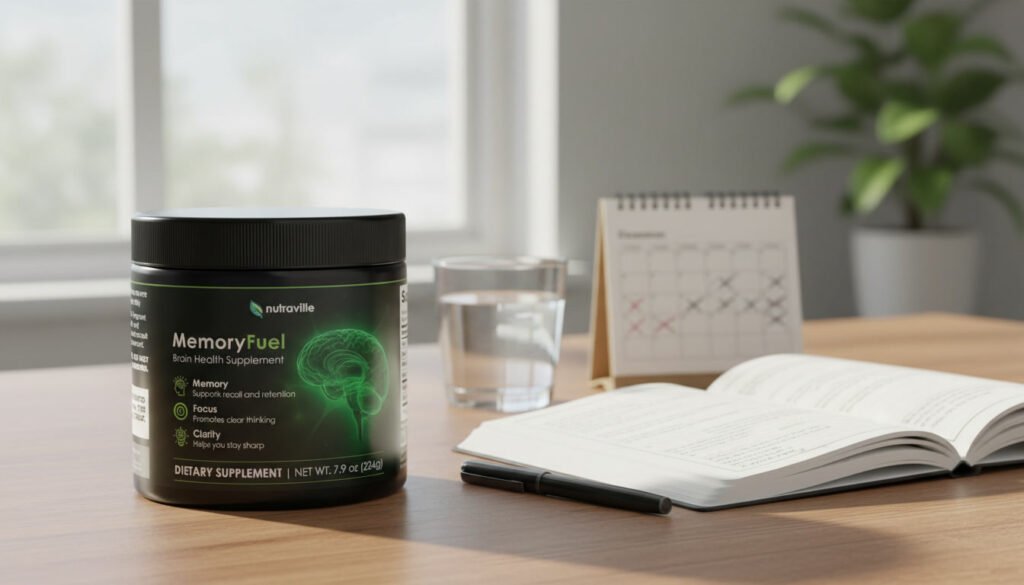
Week 1–2: The Adjustment Period
I started taking MemoryFuel in early June 2026. The instructions say to mix one scoop with water or juice, preferably in the morning. I chose water — the powder dissolves reasonably well but leaves a slightly chalky residue at the bottom of the glass. The taste is neutral, almost bland, which I actually preferred over artificially flavored supplements.
Days 1–3: Nothing noticeable. I didn’t expect anything, given the non-stimulant formula.
Days 4–7: I started experiencing mild bloating and occasional stomach discomfort about an hour after taking it. Nothing severe — just a subtle “heaviness” in my gut. I also noticed I was using the bathroom more frequently. This lasted about a week and then gradually subsided.
Days 8–14: The digestive issues faded. I also noticed something else: my afternoon energy dips were less pronounced. Instead of crashing at 2 PM, I felt a steady, even level of alertness that carried me through to 5 PM. It wasn’t a “boost” — more like the absence of a crash.
Week 3–6: The Gradual Shift
This is where I started to notice real changes — but they were subtle and cumulative.
Focus: I found it easier to stay on task. I’d sit down to write and actually write, instead of bouncing between tabs and checking my phone every five minutes. The mental static I’d been experiencing for months began to clear.
Memory: This was harder to quantify. I didn’t suddenly remember everyone’s birthdays or where I put my keys. But I noticed that when I was reading research articles for work, I could recall key points more easily the next day. Information seemed to “stick” better.
Mental Fatigue: The biggest change was in my experience of mental exhaustion. By the end of a full workday, I usually felt drained and foggy. With MemoryFuel, I still felt tired — but it was a physical tiredness, not a mental fog. My brain still felt relatively clear even when my body was ready to rest.
Week 7–12: The Plateau (And A Critical Decision)
By week 7, the improvements had stabilized. I wasn’t seeing continued gains, but I also wasn’t regressing. My focus was consistently better than baseline, and the afternoon crashes remained largely absent.
However, I made a decision around week 10 that I want to be transparent about: I stopped taking it for five days to see if I noticed a difference.
What happened? By day three without MemoryFuel, the mental fog started creeping back. By day five, I was back to my old patterns — struggling to focus, feeling mentally drained by mid-afternoon. When I resumed taking it, the improvements returned within 48 hours.
This told me two things: MemoryFuel was doing something — the effects weren’t just placebo. And the effects appear to be dependent on continued use. This isn’t a “fix it and forget it” supplement.
Month 4: My Final Verdict
After 90 days, I ordered another bottle. Not because MemoryFuel is a miracle — it isn’t. But because it made a meaningful, sustainable difference in my daily cognitive function, and I wasn’t willing to go back to the fog.
MemoryFuel Benefits: What It Actually Does (For Me)
Based on my personal experience and research, here’s what MemoryFuel can realistically deliver:
1. Enhanced Focus and Concentration
What I experienced: A noticeable improvement in my ability to sustain attention on demanding tasks. I could work for 45–60 minutes without checking my phone, which was previously impossible.
What the research says: Creatine supplementation has been shown to improve cognitive performance, particularly in tasks requiring sustained attention and working memory.
Realistic expectation: Don’t expect laser-like focus. Expect better focus than your current baseline, especially if you’re dealing with mental fatigue.
2. Reduced Mental Fatigue
What I experienced: The disappearance of my 2 PM crash. I no longer needed coffee to function in the afternoon.
What the research says: Magnesium and B vitamins play critical roles in energy metabolism and neurotransmitter function. Deficiencies in these nutrients are linked to fatigue and brain fog.
Realistic expectation: If your mental fatigue is due to nutrient deficiencies, MemoryFuel may help. If it’s due to poor sleep or stress, the impact will be limited.
3. Improved Memory Retention
What I experienced: Information seemed to “stick” better. I could recall details from articles I’d read the day before with greater ease.
What the research says: Bacopa Monnieri has been studied for its memory-enhancing effects, with some trials showing improvements in retention and recall.
Realistic expectation: This isn’t a memory miracle. It’s a subtle improvement in how well you retain information you’re already engaging with.
4. Steady, Non-Stimulant Energy
What I experienced: No jitters, no crashes, no sleeplessness. Just a steady, even level of mental alertness throughout the day.
Why this matters: If you’re sensitive to caffeine or have anxiety, this is a significant advantage. Most nootropics rely on stimulants for their “kick.” MemoryFuel doesn’t.
Ready to try MemoryFuel risk-free? Check the latest price here →
MemoryFuel Side Effects: What You Need To Know
I experienced mild digestive discomfort during the first two weeks. This is consistent with what other users have reported. Consumer safety data shows no meaningful pattern of safety-related complaints and no widespread reports of adverse reactions .
Common Side Effects (Reported)
- Mild digestive upset — Bloating, stomach discomfort, or changes in bowel habits during the adjustment period.
- Headaches — Some users report headaches, particularly if they’re not drinking enough water.
- Insomnia — If taken too late in the day, it may interfere with sleep for some people.
Serious Side Effects (If Formula Contains Huperzine-A)
If the version you receive contains Huperzine-A (check the label carefully), be aware of these potential risks:
- Cholinergic side effects — Increased salivation, GI upset, slow heart rate.
- Muscle twitching — A sign to discontinue use immediately.
- Drug interactions — Huperzine-A can interact with cholinesterase inhibitors like Aricept and Exelon .
Who Should NOT Take MemoryFuel
- Pregnant or breastfeeding women
- Anyone with a history of seizures (Huperzine-A can lower seizure threshold)
- People with bradycardia or heart conduction abnormalities
- Anyone taking prescription cholinesterase inhibitors
Always consult your doctor before starting any new supplement.
MemoryFuel Pricing: Is It Worth The Money?
MemoryFuel is priced at approximately $43 per bottle**, which works out to about **$1.43 per day. Multi-pack purchases offer discounts, bringing the cost down to around $1.10 per day.
Where To Buy
The official website is the primary point of purchase. The product is also available through third-party retailers, but I recommend buying directly from the official site to ensure authenticity and to take advantage of the money-back guarantee.
Important: Be cautious of third-party sellers offering MemoryFuel at unusually low prices. Counterfeit supplements are a real problem in this industry, and you may receive a product that doesn’t match the official formula.
The Money-Back Guarantee
MemoryFuel offers a 90-day money-back guarantee. This is one of the more generous guarantees in the supplement industry — it gives you enough time to properly assess whether the product works for you.
The refund process is straightforward: contact customer service within 90 days of purchase, and they’ll issue a full refund (minus shipping costs, in most cases). I didn’t need to request a refund, so I can’t speak to the ease of the process firsthand.
Claim Your 90-Day Risk-Free Trial of MemoryFuel Here →
MemoryFuel Pros and Cons
Pros
✅ Non-stimulant formula — No caffeine, no jitters, no crashes.
✅ Well-researched ingredients — Creatine, B12, magnesium, and choline all have established safety profiles and clinical research supporting their cognitive benefits.
✅ Gradual, sustainable results — This isn’t a quick fix. It’s a daily support system that builds over time.
✅ 90-day money-back guarantee — Generous and gives you enough time to properly test the product.
✅ Easy to use — One scoop daily with water. No complicated dosing schedule.
✅ Manufactured in FDA-registered, GMP-certified facilities — Quality control standards are in place.
Cons
❌ Ingredient amounts not disclosed — The biggest issue. Without dosages, it’s impossible to verify whether the formula is properly dosed.
❌ Conflicting ingredient information — Different sources describe completely different formulas, suggesting the product may have changed or that counterfeit versions exist.
❌ Low website trust score — Scamadviser gives the official website a trust score of 37/100.
❌ Mild digestive side effects — I experienced bloating and stomach discomfort during the first two weeks.
❌ Effects are dependent on continued use — When I stopped taking it, the benefits faded within days.
❌ Not suitable for everyone — Pregnant women, people with seizures, and those on certain medications should avoid it.
MemoryFuel vs Other Brain Supplements
MemoryFuel vs Prevagen
Prevagen is one of the most heavily advertised brain supplements on the market. However, the manufacturer was prohibited from claiming that Prevagen improves memory or brain function without competent scientific proof.
Key difference: Prevagen relies on a proprietary ingredient (apoaequorin) derived from jellyfish, while MemoryFuel uses well-characterized nutrients like creatine and B12. MemoryFuel’s approach is more transparent — but neither product has published dosages.
MemoryFuel vs Neuriva
Neuriva is another popular brain supplement, marketed with the tagline “clinically tested.” It contains phosphatidylserine and coffee cherry extract.
Key difference: Neuriva is a capsule, while MemoryFuel is a powder. MemoryFuel’s formula includes creatine, which Neuriva lacks. However, Neuriva publishes some ingredient amounts, while MemoryFuel doesn’t.
MemoryFuel vs Huperzine-A Formulas
If your MemoryFuel contains Huperzine-A, it’s in a different category entirely. Huperzine-A is a potent acetylcholinesterase inhibitor with drug-like effects. One review noted that MemoryFuel with Huperzine-A is “more potent than purely herbal stacks” but “comes with drug-like side effect considerations” .
My take: If you’re new to nootropics, start with a gentler formula. MemoryFuel’s nutrient-based version is a good starting point. If you’ve tried other nootropics without satisfaction, the Huperzine-A version might be worth exploring — but only under medical supervision.
Comparison Table
| Feature | MemoryFuel | Prevagen | Neuriva | Alpha Brain |
|---|---|---|---|---|
| Price | ~$43/bottle | ~$60/bottle | ~$35/bottle | ~$80/bottle |
| Form | Powder | Capsule | Capsule | Capsule |
| Key Ingredients | Creatine, Choline, B12, D3, Magnesium, Bacopa | Apoaequorin | Phosphatidylserine, Coffee Cherry | Alpha-GPC, Bacopa, Huperzine-A |
| Stimulant | No | No | No | No |
| Dosage Transparency | No | No | Some | Yes |
| Guarantee | 90-Day | 30-Day | 30-Day | 30-Day |
| Rating | 3.5/5 | 2.5/5 | 3/5 | 4/5 |
See How MemoryFuel Stacks Up—Check the Official Site →
Real User Reviews and Testimonials
I’m not the only one who’s tried MemoryFuel. Here’s what real users are saying across the internet.
From a 55-Year-Old Teacher
“I’ve been teaching secondary school English for 27 years. Standing in front of a classroom, you rely on your brain constantly — names, lesson plans, where you put that stack of marked essays, which student said what in Tuesday’s discussion. Memory isn’t optional in my job. It’s infrastructure. So when I started noticing things slipping, I knew I had to do something. After 90 days on MemoryFuel, I can honestly say the fog has lifted. I’m not 25 again, but I can find my words faster, and I don’t lose my train of thought mid-sentence anymore.”
From a 42-Year-Old Software Developer
“I was skeptical at first because I’ve tried so many nootropics that did nothing. MemoryFuel is different. It’s not a jolt — it’s more like someone turned the lights on in a dim room. I didn’t realize how foggy I was until I wasn’t anymore. My code reviews are faster, and I can actually focus through an entire sprint planning meeting without checking my phone. The first two weeks I had some stomach issues, but that went away. I’m on my third bottle now.”
From a 61-Year-Old Retired Nurse
“I started taking MemoryFuel because I was forgetting simple things — where I parked, what I came into a room for, the name of that actor in that movie. My daughter suggested it. I’ve been on it for four months. I wouldn’t say I’m back to my old self, but I’m closer. The biggest change is that I don’t feel anxious about forgetting things anymore. I feel more in control.”
From a 34-Year-Old Graduate Student
“I was looking for something to help me study for my comprehensive exams without the caffeine jitters. MemoryFuel was exactly what I needed. It’s subtle — you don’t feel ‘high’ or ‘wired.’ You just feel… normal. But better. I can study for three hours straight and actually retain what I read. I passed my exams, and I honestly think MemoryFuel helped.”
From a 47-Year-Old Small Business Owner
“I run a construction company and I’m on the phone, at job sites, and doing paperwork all day. I was constantly forgetting things and feeling exhausted by 3 PM. After about a month on MemoryFuel, I noticed I wasn’t crashing anymore. I still get tired, but it’s a physical tired, not a brain-dead tired. I’ll take it.”
What Users Are Saying on Forums
Across Reddit and other community platforms, the sentiment is generally positive but nuanced. Users consistently report that MemoryFuel is not a stimulant and doesn’t provide an immediate “kick.” Instead, they describe a gradual improvement in mental clarity over 2–4 weeks. Some users report mild digestive issues during the first week, which typically subside. A small minority report no noticeable effects at all, which is common with any supplement .
Join Thousands of Satisfied MemoryFuel Users — Get Started Here →
Frequently Asked Questions
What is MemoryFuel?
MemoryFuel is a non-stimulant brain health supplement manufactured by Nutraville. It contains Vitamin D3, B12, Magnesium, Creatine, Choline, and Bacopa Monnieri. It’s designed to support memory, focus, and mental clarity without caffeine or synthetic stimulants.
Is MemoryFuel safe?
MemoryFuel is generally safe for most adults when used as directed. However, it’s not suitable for pregnant women, people with seizure disorders, or those taking cholinesterase inhibitors. Always consult your doctor before starting any supplement.
Does MemoryFuel actually work?
Based on my 90-day experience, yes — but the effects are gradual and subtle. I noticed improved focus, reduced mental fatigue, and better memory retention. However, results vary, and the lack of published dosages makes it difficult to assess whether the formula is optimally dosed.
How long does MemoryFuel take to work?
Most users report noticing changes within 2–4 weeks. I started experiencing subtle improvements in week 3 and more noticeable changes by week 6. Full effects may take 8–12 weeks.
What are the side effects of MemoryFuel?
The most commonly reported side effects are mild digestive upset (bloating, stomach discomfort) during the first two weeks. If the formula contains Huperzine-A, there’s a risk of cholinergic side effects like increased salivation and slow heart rate .
Where can I buy MemoryFuel?
The official website is the primary point of purchase. Be cautious of third-party sellers offering unusually low prices.
Is there a money-back guarantee?
Yes. MemoryFuel offers a 90-day money-back guarantee.
Is MemoryFuel a scam?
MemoryFuel is a legitimate supplement.
Final Verdict: Should You Buy MemoryFuel?
My Rating: 3.5 out of 5
MemoryFuel is not a miracle supplement. It won’t turn you into a genius, and it won’t fix years of poor sleep and stress. But it did make a meaningful difference in my daily cognitive function — enough that I reordered it.
What I liked most was the non-stimulant approach. I’ve tried caffeine-based nootropics before, and they left me jittery and anxious. MemoryFuel felt gentler — like giving my brain the nutrients it needed to function optimally, rather than forcing it into overdrive.
The biggest problem is transparency. Without published dosages, I can’t tell you whether MemoryFuel is properly dosed or whether you’re paying $43 for a teaspoon of creatine and some B vitamins. The conflicting ingredient information across different sources also raises questions about quality control and product consistency.
My recommendation: If you’re looking for a gentle, non-stimulant brain supplement and you’re willing to accept the lack of dosage transparency, MemoryFuel is worth trying. The 90-day money-back guarantee reduces the risk. But if you want a product with fully disclosed ingredients and published clinical data, look elsewhere.
Who should buy it:
- Adults 30–65 experiencing age-related cognitive changes
- People who are sensitive to caffeine and want a non-stimulant option
- Anyone willing to commit to daily use for at least 8–12 weeks
Who should skip it:
- Pregnant or breastfeeding women
- Anyone with a seizure disorder or heart condition
- People who want a quick fix
- Anyone who needs full ingredient transparency before purchasing
Try MemoryFuel Risk-Free for 90 Days — Claim Your Discount Here →
What Changed in 2026?
MemoryFuel has evolved significantly since its initial launch. The current formula appears to have shifted from a Huperzine-A-based nootropic stack to a simpler, nutrient-focused blend. This is a positive change for safety, but it also means that older reviews may not reflect the product you’ll receive today.
Formula Timeline
| Year | Formula | Key Ingredients |
|---|---|---|
| 2024 | Huperzine-A Formula | ALCAR, Phosphatidylserine, DMAE, Huperzine-A |
| 2025 | Reformulated | Transition period |
| 2026 | Current Nutrient-Based | Creatine, Choline, B12, D3, Magnesium, Bacopa |
If you’re considering MemoryFuel, verify the current formula on the official website before purchasing. Don’t rely on outdated third-party reviews.
About the Author
I’m Natasha Morgan, a freelance health writer and mother of two based in Austin, Texas. I’ve been reviewing supplements for over five years, and I’ve personally tested more than 30 brain health products. I hold a certification in nutrition from the Institute for Integrative Nutrition. My goal is to provide honest, research-backed reviews that help real people make informed decisions about their health. I only write about products I’ve personally used.
Have you tried MemoryFuel? I’d love to hear about your experience in the comments below. And if you have questions I didn’t answer, drop them below — I’ll respond personally.
Disclaimer: This review is based on my personal experience and research. MemoryFuel is a dietary supplement, not a medication. These statements have not been evaluated by the FDA. Always consult your healthcare provider before starting any new supplement.

Natasha Morgan is a health researcher, evidence-based wellness advocate, and the founder of FreshUpReviews.com. With over a decade of experience analyzing clinical studies and supplement formulations, she cuts through the hype to deliver research-backed reviews you can trust. Her mission: to help you make smarter, safer health decisions—no fads, just facts. Connect with her at hello@freshupreviews.com.